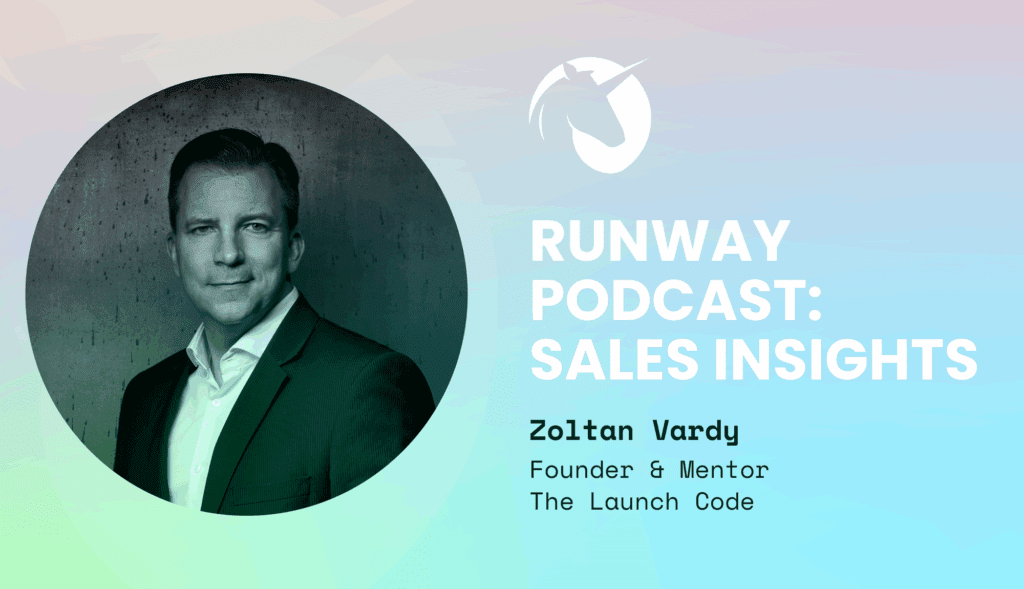
Over 30 years, Vardy has closed more than $2 billion in B2B sales deals, bouncing between corporate giants like NBCUniversal and CBS before diving headfirst into the startup world. But here’s the kicker: that modest $50K deal he landed as a startup founder? It taught him more about real sales than all those corporate mega-deals combined.
Today, Vardy is the founder behind the Launch Code, a system that’s helped over 200 early-stage startups across 26 countries figure out how to sell without the safety net of a corporate logo. On the Runway Podcast with host Mauro Battellini, he spilled the beans on why startup sales is a completely different beast and how founders can actually win at it.
Know That As A Startup, You’re Starting From Behind the Starting Line
Let’s get real about something most sales gurus won’t tell you: enterprise sales for startups isn’t just hard because the deals are complex. It’s hard because you’re not even playing the same game.
When Vardy worked at NBCUniversal, every meeting started with instant credibility. The logo did half the work before he even opened his mouth. Brand recognition? Check. Internal resources? Double check. Trust? Already in the bank.
As a startup founder? You get none of that. Zero. Zilch. Nada.
“When you’re in corporate,” Vardy explains, “you’re running the 100-meter dash from the 50-meter line. As a startup, you’re starting from behind the line entirely.”
But here’s where it gets interesting. Vardy doesn’t see this as a disadvantage. He sees it as startup sales’ secret weapon. When you strip away all the corporate fluff, what’s left is pure connection between a real problem and a founder crazy enough to solve it. And in that arena? Startups can absolutely dominate.
The $50K Deal That Changed Everything: Enter Founder-led Sales
Before creating the Launch Code, Vardy was living the corporate dream. He managed hundreds of millions in ad revenue, negotiated deals that would make your head spin, and led global teams that most people only dream about. Then he decided to become an entrepreneur and pitch HP on a media-tech concept.
Reality check time.
That $50K deal required more sweat, more personal investment, and more creative problem-solving than any of his previous $50M+ corporate victories. But it also cracked the code on something crucial: when you don’t have the brand, the infrastructure, or the resources, what prospects are really buying is you.
For founders, that’s both terrifying and magical. Terrifying because there’s nowhere to hide. Magical because authentic connection beats corporate BS every single time.
Stop Trying to Outsource Your Way Out of Sales
Here’s some tough love: if you’re a founder trying to hire your way out of doing sales, you’re doing it wrong. Especially in the early days when your company’s identity is still forming and your product is evolving faster than a teenager’s mood, you need to be in that room.
Vardy is brutally clear on this point. “Too many founders think of sales as something separate from product,” he says. “But without a direct understanding of how customers perceive your solution, you won’t know what you’re really selling.”
This isn’t just about closing deals. It’s about building the mindset that turns good salespeople into great ones. A founder who has spent hours explaining their product to skeptical buyers will emerge with sharper positioning, stronger messaging, and a deeper understanding of their market than any hired gun could ever provide.
Death to Spray-and-Pray
Let’s talk about the two most common startup sales strategies, both of which are about as effective as a chocolate teapot:
Strategy #1: The “I Know a Guy” approach. Your entire B2B sales strategy depends on your college roommate’s cousin who works at a Fortune 500 company.
Strategy #2: The “Blast and Hope” method. Send 1,000 templated cold emails and pray something sticks.
Vardy calls both strategies fundamentally flawed, and he’s right.
His approach? Precision over volume. Start with a clearly defined ideal customer profile. What industry? What size? What role does your buyer actually hold? What specific pain keeps them up at night that your product can solve?
Once you have those answers, identify a manageable list of 50 to 100 companies that truly fit that profile. Then comes the real work: getting in front of them through warm touchpoints, shared connections, live events, or content engagement.
Vardy’s own example? He landed a bestselling author and CNBC host for his podcast with a single cold email that started with “Fellow Cornellian.” That level of relevance and personalization beats any fancy sales deck.
Pain As Your North Star
Founders love their products like parents love their children. But here’s the uncomfortable truth: customers don’t buy features. They buy solutions to painful problems.
If your buyer doesn’t feel the pain, there’s no sale. Period.
Vardy breaks this down using a simple framework: there’s shark-bite pain (urgent, expensive, existential) and mosquito-bite pain (annoying but ignorable). Startups need to find buyers who are already experiencing shark bites and then clearly demonstrate how they can stop the bleeding.
Too many sales conversations die because founders pitch solutions to people who either don’t recognize the problem or don’t care enough to fix it. “No pain, no sale,” Vardy says. “And you can’t force someone to feel the pain.”
From Chaos to System
Sales for solo founders often feels like controlled chaos. Every deal is different, every conversation is a one-off, and nothing feels repeatable. Vardy’s Launch Code exists to transform that chaos into a system that actually works.
Step one is clarity. Can you explain your product in one sentence using plain English? Do you have customer messaging that guides prospects through a clear journey from problem recognition to proof to next step? If not, stop everything else and fix this first.
Once that foundation is solid, Vardy helps founders build a structured acquisition process for B2B sales combining outbound sales, partner-led introductions, and inbound marketing. He’s particularly bullish on partnerships as a growth driver.
“Startups lack two things: credibility and reach,” he explains. “By partnering with distributors, agencies, or other companies who have both, you can borrow their reputation and extend your visibility.”
The final piece? Operational scalability. Having the tools, KPIs, roles, and processes that let founders gradually step back from day-to-day sales while maintaining visibility and control.
Events Are Powerful
In our digital-everything world, it’s tempting to think events are old school. Vardy thinks that’s exactly why they work so well.
Whether you’re walking the floor at an industry expo or speaking at a niche meetup, events eliminate the biggest friction in B2B sales: the fear of being sold to. Everyone expects to connect, which levels the playing field for startups trying to meet buyers.
But here’s the crucial part: the magic doesn’t happen during the handshake. It happens in the follow-up. Reach out within 24 hours, connect on LinkedIn, and book follow-up calls while the memory is still fresh.
Hiring for Sales: When and whom?
Eventually, every founder hits the wall. Too much pipeline, too many demos, not enough hours in the day. The instinct is to hire a “real” salesperson, preferably someone with an impressive resume from a well-known company.
Vardy’s warning: this hire can kill your growth.
Those polished VPs from big companies? They’re used to structure, brand support, and inbound demand. Strip all that away, and many of them flounder harder than a fish on dry land.
Instead, hire for mindset. Look for someone who thrives in chaos, loves building systems, and knows how to sell without a net. They might not have the most polished LinkedIn profile, but they’ll be the ones who actually move the needle.
Sales as Strategy Beyond Function
At the end of the day, Vardy sees sales as more than just a function. Done right, it becomes the heartbeat of strategic thinking. Sales conversations surface real objections, reveal product gaps, and teach you how your market actually works.
A founder who masters sales isn’t just driving revenue. They’re clarifying their company’s reason for existing. And that’s what makes the Launch Code more than just another sales toolkit. It’s a complete mindset shift.
Because when you’re starting from behind the starting line, you need more than tips and tricks. You need a fundamentally different approach to the game.
Want to hear it straight from Zoltan? Listen to the full episode of The Runway Podcast featuring Zoltan Vardy.
More advice, tips and tricks from our podcast guests:
Financial Times Contributor Nick Huber Tells Us What Every Startup Founder Should Know About Comms
5 Key Lessons from Eric Melchor on Podcasting and Building a B2B Community
5 Essential LinkedIn Lessons with Kotryna Kurt of Linkedist
How to plan, write and pitch the perfect op-ed: insights from op-eds expert Jake Meth
B2B Tech Marketing Insights from Silicon Valley Veteran Gregory Kennedy
Fundamentals of B2B Marketing with Julieta Varsano of Upvest