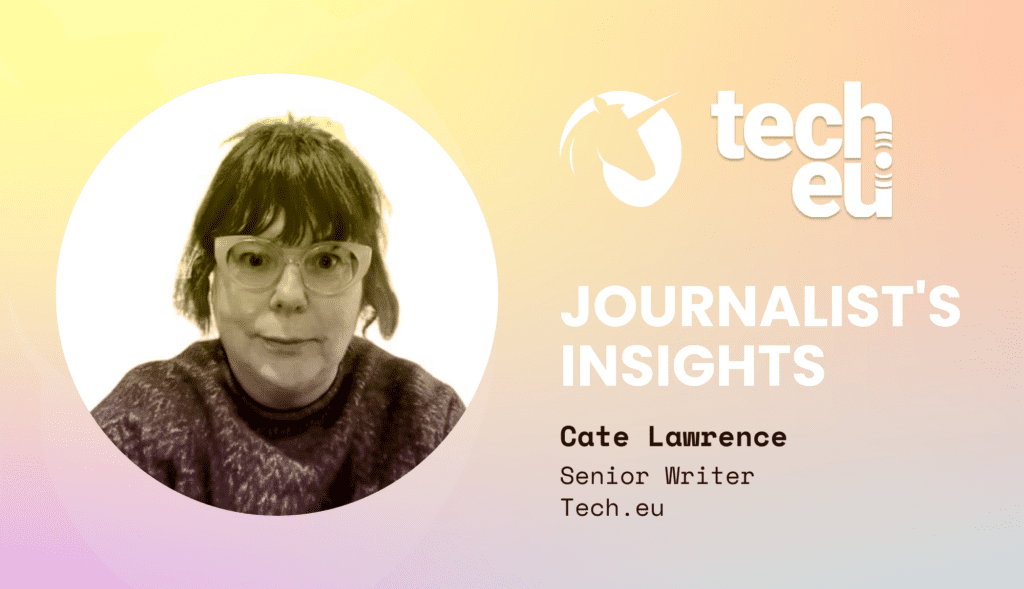
Guess, what? Runway is back! And we had the pleasure of hosting none other than Cate Lawrence from Tech.eu. With over a decade of experience covering European tech across publications like The Next Web, DZone, ReadWrite, and now Tech.eu, Cate has seen the ecosystem evolve from its scrappy early days to the complex, fast-moving landscape it is today. Originally from Australia, where she co-founded an NGO in sustainability, Cate arrived in Berlin (after a pit stop in Leipzig) at a time when the city’s tech scene was still finding its feet, and she grew alongside it.
She recently joined JJ and Mauro on The Runway Podcast to talk about what makes a story land, how founders can increase their chances of coverage, the state of European tech, and why AI is creating a strange new tension between founders and the journalists who cover them.
What follows is a summary of the main insights she shared on the pod.
1 – Not Every Announcement Is a Story (But Every Startup Has One)
One of the clearest messages from Cate is that a funding announcement alone isn’t enough to guarantee coverage. Yes, Tech.eu covers funding rounds, and Cate is the first to acknowledge that for many founders, closing a round is the highlight of their career. But the story behind the announcement is what makes a piece worth writing.
What gets her attention? A founder with deep domain experience who spotted a gap and built something to fix it. A personal motivation, whether it’s a health condition in the family, an injustice they want to address, or simply a strange and interesting idea. She mentions a Romanian startup called Bible Chat that’s succeeding in the US. As the name suggests, it’s an AI-powered app used by priests to create sermons, as an example of something that caught her eye precisely because it was unexpected.
On the flip side, stories that tend to fall flat include routine staff movements, vaguely articulated partnerships, and reports or books sent without enough context or notice. If the “so what” for the reader isn’t immediately clear, it’s a hard sell.

2 – Give Journalists More Time (Seriously, More Than You Think)
If there’s one refrain that runs through the entire conversation, it’s this: give journalists more notice. Cate receives around 180 pitches a day. That number has only grown as several European tech publications have closed recently, concentrating inbound attention on fewer outlets.
The problem isn’t just volume — it’s the back-and-forth. Missing images, unclear embargo dates, no website link, absent timezones. Each of these small gaps creates a chain of follow-up emails that eats into already-packed schedules. A press release landing on a Friday afternoon for a Monday morning embargo is, in her words, setting yourself up to fail.
Her recommendation? A week’s notice minimum for a news piece. Two weeks if you’d like an interview. And if you’re sending a 70-page report, don’t send it at 9am on the day of publication and expect in-depth coverage.
3 – Make Yourself Easy to Find (Because Journalists Do Their Own Research)
One point that may surprise some founders is that journalists aren’t just passively waiting for pitches. Cate spends a significant portion of her time doing outbound research and scouting startups for thematic roundups, sector deep-dives, and trend pieces. She’ll search databases, browse LinkedIn, check company websites, and look for recent activity.
This is where many startups unknowingly disqualify themselves. If your most recent update is from 2022, or your website doesn’t link to your LinkedIn, or your LinkedIn doesn’t link to your website, you’re invisible at the moment when a journalist is actively looking for companies like yours.
Her practical advice is simple: keep your digital presence current, make your contact information easy to find, and consider building a lightweight press kit. She’s seen some startups do this well using tools like Notion. A simple page with founder bios, images, recent news, and basic company information. It’s easy to update and gives journalists everything they need without the back-and-forth.
4 – The State of European Tech: Optimism, With Caveats
Cate is broadly optimistic about European tech right now. She points to growing momentum across the continent: new unicorns emerging, significant funding rounds, factories being built, startups scaling, and initiatives like EU Inc gaining real traction. The geopolitical shifts in the US, she notes, are creating a window of opportunity for Europe to champion local products and homegrown alternatives.
But she’s careful not to paint a one-sided picture. Alongside the good news, she’s seeing significant layoffs — particularly in Berlin — and a wave of acquisitions at the end of last year that may, in some cases, have been closer to fire sales than strategic moves. There’s also an underlying public anxiety about AI, particularly around job displacement, that the tech world doesn’t always acknowledge.
Geographically, she’s especially bullish on Poland (particularly Warsaw), as well as Italy and Greece. She also highlights smaller ecosystems like Armenia and Moldova, where favourable tax environments and digital-first infrastructure could allow them to leapfrog the bureaucratic legacy that larger markets still struggle with.
5 – The Changing Media Landscape: More Formats, Same Resource Crunch
When asked about the rise of non-traditional media: video, podcasts, newsletters, Substacks. Cate takes a pragmatic view. People have always consumed news in different ways, and the emergence of new formats and independent voices is neither surprising nor inherently threatening to traditional journalism.
What she does find challenging is that established newsrooms want to experiment with these formats too, but lack the resources. It’s not a question of willingness, it’s time and team size. And for those going independent, the pressure to constantly self-promote and build a personal brand takes time away from the actual journalism.
In her view, there’s enough news for everyone. The real competition isn’t between journalists and podcasters, it’s between everyone and the clock.
6 – AI and the Strange New Tension Between Founders and Journalists
Perhaps the most striking insight from the conversation is about AI’s unexpected impact on the relationship between founders and the press. Cate observes that as startups increasingly use AI to craft their press materials, bios, and public-facing language, a gap has opened up between the polished “AI version” of a founder and how they actually sound in conversation.
The result? Founders sometimes push back on their own quotes after an interview, not because they were misquoted, but because they don’t sound like the AI-generated version of themselves. They want to be the slick, jargon-perfect persona from their press release, rather than the natural, slightly imperfect person who spoke in the interview.
For Cate, this is deeply counterproductive. The natural voice, the real origin story, the genuine enthusiasm, the candid explanation, is exactly what makes a piece engaging. A colourless, AI-polished quote doesn’t excite anyone. If everything sounds the same, nothing stands out.
7 – The Origin Story Still Matters Most
Throughout the conversation, one theme keeps surfacing: Cate is drawn to people, not products. Whether it’s a founder who started a company after time in prison, a magician who built a tech startup, or a university researcher who can explain quantum computing in plain language, the human element is what elevates a story from news to something worth reading.
She particularly values founders from university spinouts, noting that their academic background often makes them surprisingly good communicators. Having spent years presenting research, teaching students, and defending theses, they tend to be skilled at explaining complex topics simply, a quality that’s often underestimated but essential for media coverage.
Her advice to founders: don’t hide behind corporate language. Lead with who you are and why this matters to you. That’s the story journalists want to tell.
For more from Cate Lawrence, follow her on LinkedIn or reach her at cate@tech.eu.
Main Takeaways from our conversation with Cate
Student of PR, comms or tech journalism? If you’re not able to listen to the whole conversation, here’s a good primer on tips she mentioned:
- A funding announcement opens the door, but a compelling founder story is what gets a piece written
- Give journalists at least a week’s notice! Two weeks if you want an interview
- Send complete press kits: images, website links, embargo dates, and timezone-clear timings
- Keep your digital presence current, journalists are actively researching, not just waiting for pitches
- Consider building a simple press kit (e.g., on Notion or similar) that’s easy to update as your company evolves
- Partnerships and staff moves rarely make interesting stories unless clearly tied to reader impact
- Don’t let AI polish away your personality! Your natural voice is your biggest asset in media
- European tech is in a strong position, but don’t ignore the nuance: layoffs and anxiety coexist with optimism
- Smaller ecosystems (Poland, Italy, Greece, Armenia) are worth watching closely
- If you can explain what your company does in plain language, you’re already ahead of most pitches
🎧 This article is based on a conversation from The Runway Podcast featuring Cate Lawrence. Listen to the full episode for the complete chat.
Want more smart, no-BS insights from top journalists? Follow Black Unicorn PR for new episodes, expert blogs, and useful content.
Enjoyed the insights from Cate Lawrence? Check out the rest of our blog and our Journalist’s Insights series:
Into the world of cybersecurity journalism with Danny Palmer
Financial Times Contributor Nick Huber – What Every Startup Founder Should Know About Comms
Startups, news and beyond with Stefano De Marzo of EU Startups
Mad about startups with David Johnson of Maddyness UK
Ioanna Lykiardopoulou from The Next Web
Startups, the Media and CEE with Zosia Wanat from Sifted
Bojan Stojkovski from The Recursive
The importance of regional media for startups, with Anda Asere from Labs of Latvia