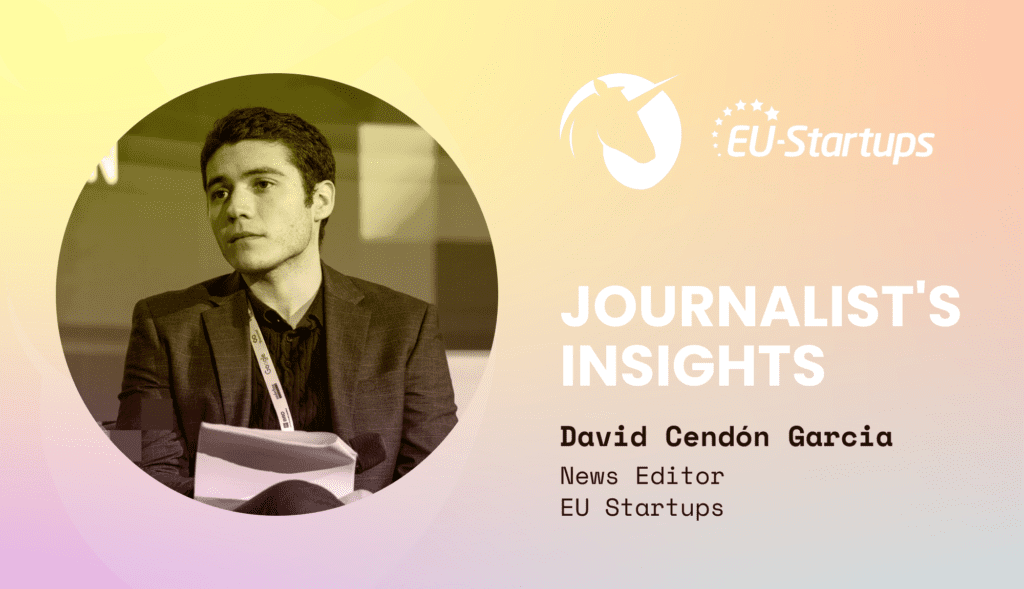
David Cendón Garcia has one of the most eclectic career paths you’ll come across in European startup media. Born in Spain, raised in Montana, he studied journalism at the University of Galway before joining the newsroom at the Irish Independent, one of Ireland’s national papers, where he learned to think on his feet and cover anything, fast. From there, he moved into diplomatic communications at the Embassy of Ireland in Spain, then into consultancy work for the European Commission, before landing at EU Startups as News Editor.
That combination of journalism, diplomacy and policy experience is not incidental to the way he works. It shapes how he reads a story, what context he brings to it, and why he thinks about the European startup ecosystem in unusually broad terms.
David joined JJ and Mauro on The Runway Podcast to talk about EU Startups’ editorial identity, what makes a pitch worth reading, the sectors that keep slipping under the radar, and where European tech is headed. What follows is a summary of the main insights he shared on the pod.
BY THE WAY!
Before you jump into it: David and his lovely team have given us a special perk for the EU Startups Summit 2026. We got a special 25% discount code for you with the code BlackUnicorn25 – valid until end of March! See you in Malta?
1 – European Tech’s Defining Moment
Having had hundreds of conversations with European founders across the editorial calendar, David has noticed a shift that he finds genuinely exciting. The most successful founders, the ones at the front of the line, who built their companies at a time when going to San Francisco felt like the obvious move, are now among the loudest advocates for staying in Europe and building here.
They’re on record saying it. They want to be on record saying it. And that marks a real change.
Beyond that cultural shift, David points to several areas where European tech is accelerating. Defence tech is moving fast, with obvious geopolitical context. Data centre infrastructure is gaining momentum across the continent. EU Inc, the proposed 28th regime for European companies, has attracted almost no opposition and a great deal of enthusiasm. And the “buy European” impulse, amplified by events like the Spanish energy grid crisis and the Cloudflare outage, is starting to show up in editorial decisions at EU Startups itself, with more coverage of European alternatives to American platforms.
2 – Context Is EU Startups’ Real Competitive Advantage
In a media landscape where American outlets have retreated from European coverage and new publications keep emerging, David is clear about what EU Startups brings to the table: institutional memory and depth of context.
EU Startups has been covering the ecosystem for long enough to reference what happened two, three, five years ago, and to give readers a bridge into why a particular piece of news matters beyond the headline. When NScale raises a billion, David doesn’t just report the number. He asks what else is happening in physical AI infrastructure across the continent, which companies have raised in the same space recently, and why Germany might be emerging as a particular hotspot.
This is the thing EU Startups can do that a newer publication simply can’t. And it’s the thing David leans into deliberately. His measure of a good article isn’t whether it breaks the news first. It’s whether it gives readers something they wouldn’t have got elsewhere.
3 – What David Actually Wants in a Pitch
When a pitch does catch his attention, David sends a template email asking for a standard set of materials. It’s not a long list, but the gaps are surprisingly common.
At the top: images. Specifically, landscape images. He’s not a designer. He can’t do much with a portrait-format headshot, and he’s genuinely frustrated by how often he has to choose between zooming in on someone’s face, using AI tools to expand a background, or simply publishing something that looks bad. A team photo in landscape format solves this instantly.
Beyond images: quotes are essential. The more a journalist can include from the start, the richer the piece, and the less back-and-forth is required. A website link, surprisingly often missing, matters more than it sounds when four companies share the same name. And founding year, location, and a short company description are baseline requirements that regularly arrive incomplete or absent.
On undisclosed funding rounds, David’s position is pragmatic: he’ll always try to get a number, or at least an approximation. “More than €2 million” is publishable. A round with no figure attached is hard to contextualise for readers, and harder to justify covering.
4 – Exclusives and Embargoes: How to Use Them Properly
David is an enthusiastic advocate for exclusives. When a company offers EU Startups an exclusive, it signals that they’ve thought about who they’re pitching and why. It creates a sense of occasion for the publication, and it tends to result in better, more considered coverage than a simultaneous send to twenty outlets.
That said, an exclusive is not a guarantee of publication. It’s an offer that gets taken more seriously, not a transaction with a fixed outcome. The terms, timing, scope, and what “exclusive” actually means should be agreed clearly upfront between the PR and the journalist.
On embargoes: the earlier, the better. An embargo landing a week before publication gives David time to identify what’s missing, request additional quotes, think about the angle, and plan where it sits in the editorial calendar. An embargo landing the evening before gives him none of that. It’s not that he won’t try, but the quality of coverage, and the likelihood of it, goes up significantly with notice.
5 – Deep-Sector Startups Are Missing Out on Coverage They Deserve
Ask David which sector he wishes he received more pitches from, and the answer is health tech, specifically the deep clinical side, not wearables and wellness apps. Companies using AI to address chronic illness, to work on Alzheimer’s, to develop treatments for conditions that don’t have good solutions yet. These companies are raising significant rounds, sometimes hundreds of millions, and almost none of them think to send a press release.
The same pattern appears across other deep-sector verticals: biotech, medtech, deep diagnostics. Founders in these spaces tend to be research-driven and media-shy, not because they don’t have a compelling story, but because media outreach simply isn’t on their radar.
David will often discover them by going to Crunchbase himself. And when he finds them, the next problem is that they have no materials prepared: no team photo, no company description, no founder bio, no press page. For a publication working with a small, focused team, that’s the difference between a story getting written and a story being set aside.
This is a genuine missed opportunity. Journalists want to cover deep-sector innovation. Coverage of a breakthrough in chronic illness treatment or a novel AI diagnostic platform drives real organic interest, the kind that reaches investors, potential hires, partners and customers who wouldn’t otherwise have heard of you. But it requires making the journalist’s job as easy as possible.
If you’re building something genuinely important in health tech, biotech or a similarly media-quiet sector, a basic press kit goes a long way. A landscape team photo, a short company description, founder bios, a press page on your website with a contact email. These things take an afternoon to set up and they remove the friction that causes stories to be dropped before they’re written.
6 – The Podcast and Why Human Stories Matter as Much as Headlines
David took over the EU Startups podcast from his predecessor Marcin, and his approach to it reflects something he thinks gets lost in daily news work: actual conversation with actual people.
In the newsroom, there’s rarely time to sit with a founder and understand the full arc of what they’re building. The podcast creates space for that. It’s less constrained by whether something is making news right now. It’s more interested in the person behind the company, their journey, what shaped their thinking, and what they’re really trying to do.
For David, this isn’t separate from journalism. It is journalism. Some of the best editorial instincts come from understanding the human element, not just the funding round. And in a world where everything is moving fast and every headline sounds the same, the stories that stay with readers tend to be the ones that were really about someone.
7 – Spray and Pray Is Still Very Much Alive (and Still Doing Damage)
If anyone needed reminding, here you go. If you send mass press releases without checking whether they’re relevant to the outlet you’re targeting, David will notice. Not because he keeps a blacklist, he doesn’t, but because patterns emerge quickly in an inbox receiving 200-300 emails a day.
His example is blunt: he regularly receives press releases from Israeli companies. They may be genuinely interesting. But EU Startups is called EU Startups. If you can’t take a moment to consider something that obvious, he’s switched off before he’s read the first sentence. Not out of spite, but because it signals that no one thought carefully about the pitch before sending it.
The same logic applies across the board. If you’re sending a story about the best airports to pass through security to a startup publication, you’re not just wasting a journalist’s time. You’re slowly building an association between your name and irrelevance. That’s harder to undo than most people realise.
Main Takeaways from our conversation with David
Student of PR, comms or tech journalism? If you’re not able to listen to the whole conversation, here’s a good primer on things he mentioned:
- Study the publication before you pitch — understand what they cover, who their audience is, and why your story fits
- Spray and pray doesn’t just not work — it builds negative associations with your name over time
- Always send landscape images. Portrait headshots are harder to use than most founders realise
- Include quotes, a website link, founding year, and company location as standard — these get missed constantly
- On undisclosed rounds: “more than X” is publishable. A round with no figure is difficult to justify covering
- Exclusives get taken more seriously — use them deliberately, and agree the terms clearly upfront
- Embargoes should land as early as possible. A week’s notice is a baseline; more is always better
- Deep-sector startups in health tech, biotech and medtech are significantly undercovering themselves — journalists are actively looking for them
- A basic press kit (landscape team photo, founder bios, company description, press page) removes the friction that causes stories to be dropped
- The human story behind the company matters as much as the news — don’t hide it behind corporate language
🎧 This article is based on a conversation from The Runway Podcast featuring David Cendón Garcia. Listen to the full episode for the complete chat.
Enjoyed the insights from David Cendón Garcia? Check out the rest of our blog and our Journalist’s Insights series:
Journalist’s Insights: Tech.eu Senior Writer Cate Lawrence on What Really Gets a Story Written
Financial Times Contributor Nick Huber – What Every Startup Founder Should Know About Comms
Startups, news and beyond with Stefano De Marzo of EU Startups
Into the world of cybersecurity journalism with Danny Palmer