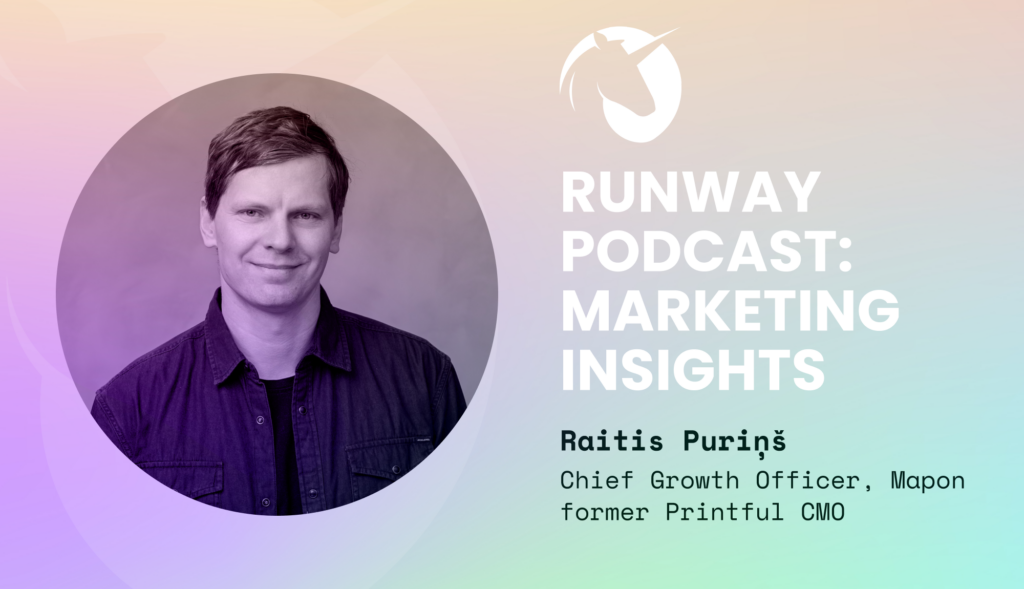
Raitis Puriņš spent seven years as Head of Marketing at Printful, joining when the marketing team was five people and leaving when it was over a hundred. In between, the company became Latvia’s first unicorn, hitting a $1B valuation in 2021 on the back of the print-on-demand boom. Before all of that, get ready… he was a computer teacher, a freelance sports journalist, a national team handball goalkeeper, and one of Latvia’s first social media marketers. Quite a colourful mix and set of abilities!
When it comes to handball, Raitis helped Latvia play its first Euros in 2020, and was until very recently still with the national team. He’s playing the final of the Latvian Handball cup next week, so we wish him luck with that!
Back to tech! Raitis now Chief Growth Officer at Mapon, a fleet management company expanding aggressively across Europe through acquisition. He joined Mauro on The Runway Podcast to reflect on the Printful years with the benefit of hindsight, share his take on the Printful-Printify merger, and explain what it’s like to rebuild a marketing playbook from scratch in B2B SaaS.
What follows is a summary of the main insights he shared on the pod. For the full episode, check below!
1. Your First Marketer Has to Be a Generalist (and That’s Not a Compromise)
When Raitis joined Printful in 2016, the marketing team was five people. They weren’t specialists in SEO or paid acquisition or content. They were generalists who could write blogs, send emails, run ads, and do some SEO. Critically, they were native-level English speakers based in Latvia, marketing to the US.
This is advice that sounds obvious but is rarely followed. Startups tend to either hire too senior too early (an expensive CMO with no one to manage) or too narrow too early (a paid ads specialist when the company doesn’t yet know which channel works). Raitis’s approach was different: hire curious people, test a lot of things, see what sticks, and once the experiments reveal enough insights, then hire specialists to double down.
“Your first marketer has to be a generalist, willing to learn, wear a lot of hats and just be curious about everything,” he says. “Then you see what works, and you hire more people to scale that.”
The first dedicated hire after the generalists? An SEO specialist, because organic search was already working. Then a blog editor. Then a video content marketer (who was also a journalist, and who did scripting, filming, and editing as a one-person team). Each new role was a response to proven traction, not a speculative bet. And potential new leaders within the team.
2. SEO Wasn’t Just a Channel. It Was THE Channel.
If there’s one conviction that runs through everything Raitis says about marketing, it’s that SEO played a crucial role in Printful’s growth, and the others weren’t even close.
The core strategy was straightforward in concept: when someone searched for anything related to print-on-demand, custom merchandise, or starting an ecommerce business, Printful would be the answer. That meant making sure that the content ranked, well before the company was spending millions on ads.
During the early days, there was no big paid media budget. Growth came from people finding Printful through Google and from Shopify’s app marketplace. Those two channels, organic search and the Shopify ecosystem, were the twin pillars. Of course, this is not just something that works for any company just like that, the context played a big role. But more on that later.
The validation of this came during COVID. When the pandemic hit, Printful cut ad spend to a minimum. Revenue kept growing. “It was just SEO,” Raitis explained. The investment they’d made in organic content and search visibility kept delivering traffic and customers even when the paid taps were turned off. For a bootstrapped company, that wasn’t just good strategy. It was survival insurance.
Raitis Purins saving a penalty for Latvia
3. With Scale, Mistakes Can Become Quite Costly
We did ask about the painful lessons. Scaling a marketing team to 100 people, and scaling the company to a unicorn… there had to be some. Raitis didn’t hesitate to tell us. When Printful launched its Wix integration, someone on the team sent an email to inactive Printful customers, inviting them to try the new integration. The problem… some of those inactive customers were Shopify employees who had Printful accounts. And the email was, in effect, promoting a competitor platform to Shopify’s own people.
The fallout was that, unfortunately, Shopify deprioritised Printful’s app in their app store for two weeks. At the time, the direct impact seemed small. But Raitis now estimates the long-term cost was millions, because those customers who couldn’t easily find Printful on Shopify during that window would have compounded in value over the following years.
Startups move fast, and that’s good. But as revenue grows, every mistake gets more expensive. At some point, you need to hire people whose sole job is to make sure errors don’t happen. “At the beginning, break everything,” he said. “But when your revenue is already a hundred million, every mistake is just more and more expensive.” He says he made sure every marketer who joined Printful after that incident heard this story.
4. Category Creation Is About Timing, Not Just Product
Printful didn’t invent printing on t-shirts. People have been doing that for decades. What Printful did was make it possible to do it on demand, with no inventory, through a seamless API integration with the platforms where ecommerce was already happening.
Raitis described a convergence of forces that made the timing perfect: Shopify was going public and growing fast (and Printful was one of its top apps); social media influencers were looking for ways to monetise their audiences; the side-hustle economy was booming; and consumers were increasingly comfortable buying online.
“Multiple factors were just building not maybe a print-on-demand category, but side hustling, extra income on the side,” he said. “And Printful was the answer to those questions.”
The origin story itself is telling. Printful’s founders had an ecommerce store called Startup Vitamins that sold motivational posters. Posters were simple to print and ship. But when they wanted to expand to t-shirts (with all the complications of sizes, colours, and inventory), they couldn’t find a supplier who could do it well on demand. So they built the infrastructure themselves, and then realised it could be a product.
For founders listening: category creation rarely starts with someone saying “let’s create a category.” It starts with someone solving their own problem and discovering others have the same one.
5. “There’s No Such Thing as Over-Communication”
When Mauro asked Raitis whether he has a marketing philosophy, the answer wasn’t about channels or tactics. It was about internal communication.
“There’s no such thing as over-communication internally,” he said. This was his most remembered principle at Printful.
The logic: if your internal stakeholders don’t understand what marketing is doing and why, the external work will suffer. Sales won’t amplify your message. Product won’t build what you need. Leadership won’t fund your experiments. One Slack message about a launch isn’t enough. You have to hit the same frequency internally that you’d want in your external campaigns.
“I have not seen a single person who has left their job because they’re complaining that their company or managers are talking way too much with them.”
It’s a simple principle, but it’s one that most marketing teams underinvest in. They optimise for external reach while neglecting the internal buy-in that makes external work possible.
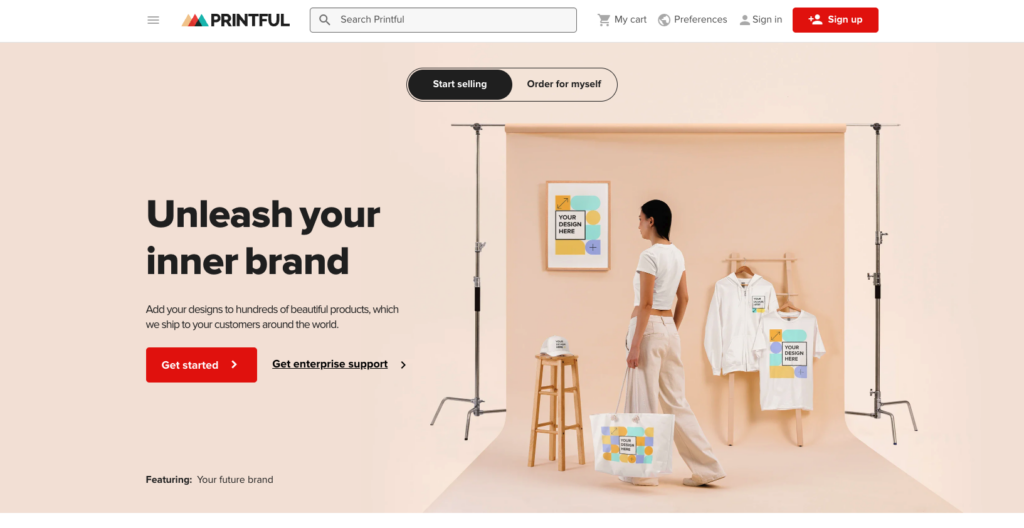
The Printful website today
6. Brand and Performance Aren’t Opponents – Your Business Model Is the Referee
This is a debate that comes up in almost every startup marketing conversation, and Raitis brought a perspective shaped by living on both sides of it.
At Printful, the business model made performance marketing dominant. Customers found the product through search, converted online, and could be tracked end to end. “We were really number driven,” he said, because the nature of the product demanded it. You couldn’t make an emotional case for print-on-demand. You needed to show people how to launch a store and make it work.
At Mapon, the picture is completely different. Revenue comes through a sales team across eight countries. The website isn’t there to convert visitors into customers. It’s there to reinforce what the salesperson said on the phone. “The website is the place you visit before and after the call,” he explained. “It has to amplify the message.”
That means brand investment, which is harder to measure, is now essential. He’s investing in expos in competitive markets like Spain, not because he can directly attribute revenue to a booth, but because prospects need to have heard of Mapon before they’ll take a cold call seriously.
His framing is worth noting: brand and performance aren’t opposing philosophies. They’re tools, and the right mix depends entirely on how your customer actually buys. He’s pragmatic about measurement, too. “Even if you’re investing in brand, which is not measurable, you’re doing that to hit your main KPI. Sometimes you’ll hit that KPI in a month. Brand takes two years.”
The lesson for founders: don’t pick a camp. Understand your customer’s buying journey and let that dictate the balance.
7. What “Chief Growth Officer” Actually Means at Mapon
Raitis was deliberate about taking the CGO title instead of CMO. The distinction matters to him. At Mapon, marketing isn’t the primary revenue driver. Sales is. The sales team operates across eight countries. Raitis doesn’t manage the closers, but he manages the SDRs (who used to sit in sales). His KPI is the same as the sales team’s: revenue.
This means his job isn’t to run campaigns. It’s to generate pipeline through whatever means work best. Sometimes that’s web ads. Sometimes it’s hiring another SDR for cold outreach. Sometimes it’s working with the product team to build something that shortens the sales cycle.
“I can do whatever I want, but with one goal: grow the company,” he said. Since joining, he hasn’t hired a single traditional marketer. Most of his changes have been in how sales and product align. He described the ideal state as three functions working together: product builds what customers need, marketing packages it with the right messaging and positioning, and sales delivers it. His role is to make that alignment real, not just aspirational.
Student of marketing, growth or comms? If you’re not able to listen to the whole conversation, here’s a good primer on the things Raitis shared:
- Your first marketing hire should be a generalist who’s curious and willing to test everything. Hire specialists only after you know what works.
- SEO was Printful’s most valuable channel because it delivered customers without ongoing ad spend. When they cut all paid ads during COVID, growth continued.
- As your company scales, the cost of every marketing mistake grows exponentially. Hire specialists to reduce errors before they become expensive.
- Category creation is rarely intentional. It’s usually someone solving their own problem and discovering the market wants the same solution.
- Internal communication is the most underrated marketing skill. If your team doesn’t understand your strategy, your external marketing won’t work.
- Your brand vs. performance balance should be determined by how your customers actually buy, not by marketing philosophy.
- A Chief Growth Officer role works when marketing alone isn’t the revenue driver. It’s about aligning sales, product, and marketing around a single growth KPI.
- Always keep 10-20% of your marketing budget for experiments with an explicit agreement that negative ROI is acceptable.
- The biggest risk at a fast-growing startup isn’t moving too slowly. It’s not having someone whose job is to prevent costly mistakes.
- Platform partnerships (like Printful’s with Shopify) can be more powerful than any ad campaign, but equally, one wrong email can put those relationships at risk.
🎙️ This article is based on a conversation from The Runway Podcast featuring Raitis Puriņš. Listen to the full episode for the complete chat.
Want more marketing insights? Check out these ones:
B2B Tech Marketing Insights from Silicon Valley Veteran Gregory Kennedy
Fundamentals of B2B Marketing with Julieta Varsano of Upvest
Why Community is the Next Competitive Edge in VC — Insights from Brighteye’s Hege Tollerud
Runway podcast: Silicon Valley veteran Gregory Kennedy on B2B startup marketing
Runway Podcast: When Comms Meets Venture Capital, with Elisheva Marcus, VP Comms at Earlybird VC