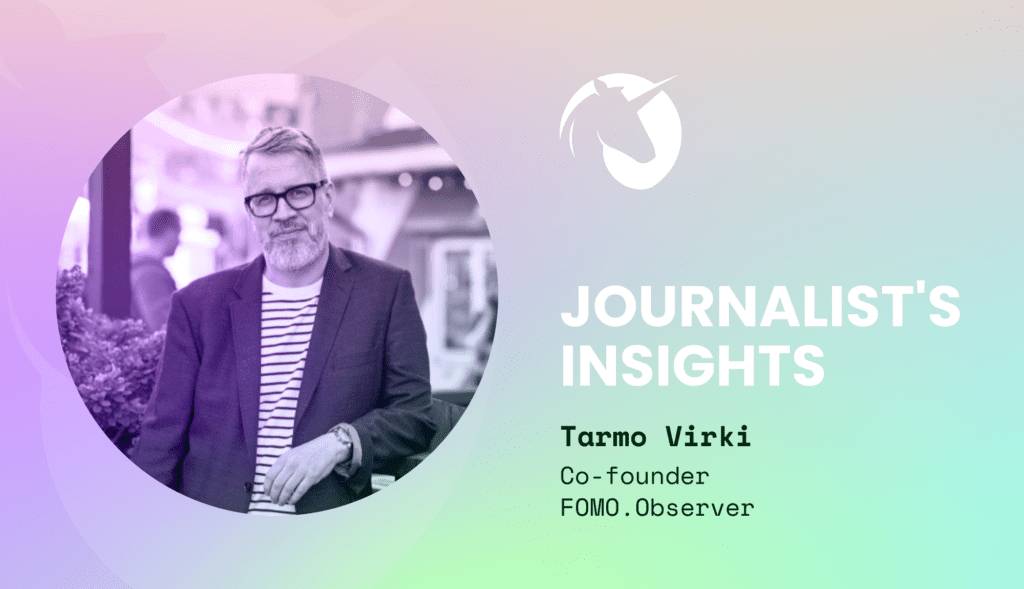
If you want to understand what journalists actually think when a pitch lands in their inbox, it helps to talk to someone who has been on both sides of the desk. Tarmo Virki has spent decades doing exactly that. And what experiences as well!
He started his career almost by accident, offered a job at Estonia’s largest daily by a stranger sitting next to him at a lecture in Helsinki in 1996. From there, he spent more than a decade covering technology at Reuters, launched his own media outlets, co-founded the nature economy podcast series Nature Backed, worked in communications at green tech startup Single Earth and hydrogen generator company PowerUP Energy Technologies, and most recently co-founded FOMO.Observer, a newsletter-led publication covering the Estonian startup ecosystem.
It’s an unusual background: editorial rigour from serious newsrooms, fluency in the startup world from the inside, and hands-on comms experience from both. He joined Mauro on The Runway Podcast to talk about what journalists want, what founders get wrong, why visuals matter more than most comms people think. Tarmo also gives us an update on the Estonian startup scene.
What follows is a summary of the main insights he shared on the pod. Happy reading!
1 – You Only Get a Few Shots a Year. Treat Them That Way.
One of the most useful framings Tarmo brings from journalism into startup PR is a simple one: most companies, regardless of size or growth stage, generate meaningful news only three or four times a year. Everything else is noise.
He references James Watt’s book Business for Punks, which makes a similar argument about BrewDog. A brand that feels like it’s constantly in the headlines, but which, if you look closely, has a limited number of genuinely newsworthy moments in any given year. For early-stage startups, the window is even narrower. A major funding round, a product launch, a significant partnership, a market expansion. These are events. Everything else tends to be a press release that journalists will skip.
So founders and comms teams should be concentrating on maximising those moments and understanding what is newsworthy for whom, rather than blasting emails like mad.
2 – Visuals Are Not an Afterthought! Plan Them Early!
Stop treating the photograph as something you scramble to find after you’ve written the press release. This is the piece of advice Tarmo comes back to again and again (and we’d agree with him!). He has his own story from PowerUP’s €10 million Series A that makes the point well.
The team knew months in advance that the round was coming. That lead time meant they could think carefully about what kind of image would tell the story. PowerUP’s founder, Ivar Kruusenberg, is a former Estonian snowboarding champion. The first idea was a shot of him in the mountains on a snowboard. It eventually evolved into something more grounded: him on a longboard with one of PowerUP’s generators, shot on a city street, planned around the available light. No studio, almost no budget. Just lead time, a clear brief, and a marketing colleague who happens to be a skilled photographer.
The result: Sifted ran the photo as the cover image for a separate story about creative ways startups announce funding rounds. Visual thinking produced earned media on top of earned media.
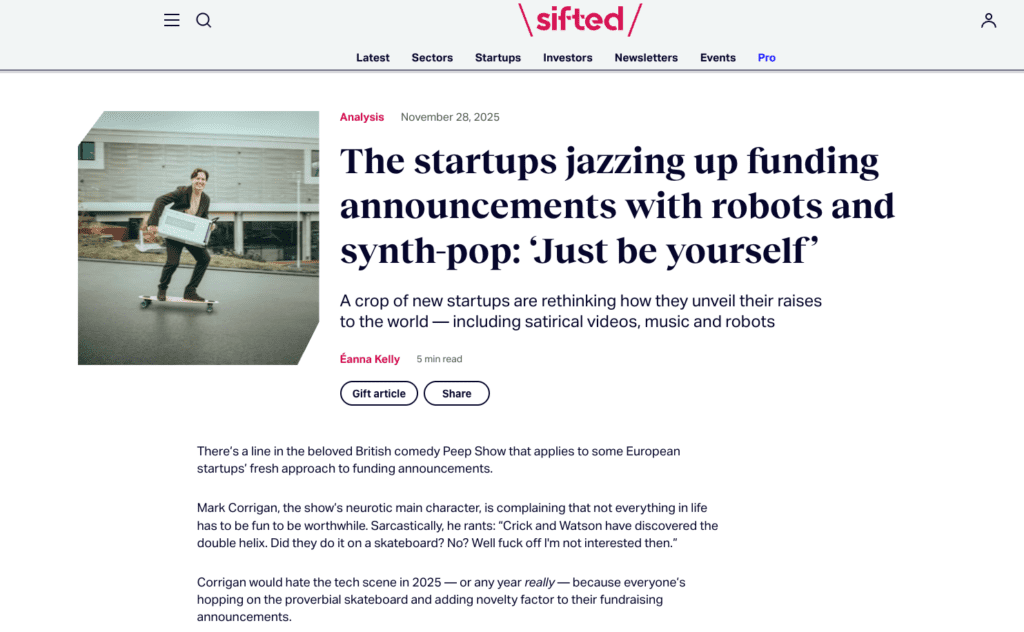
Landscape images are essential, they need to be planned in advance, and a founder’s passport photo cropped from a LinkedIn profile is not a substitute. If you’re announcing something significant, start with the visual brief, it may take longer to put together the photos than the release.
3 – Crossing to the “Dark Side” Changes What You Know, Not What You Believe
Tarmo is candid about what usually moves journalists into communications roles. It’s rarely ideology. It’s a combination of network effects and practical opportunity. Journalists build deep relationships with the companies they cover, and those companies are often better placed to offer the next job than rival media outlets are. Especially in times like these when it seems that layoffs are never-ending. Tarmo points out that his network, after years in newsrooms, consisted far more of company-side contacts than fellow journalists (who would’ve known!?). So the transition was almost logical.
What makes it useful rather than just opportunistic is that it reframes how you read a newsroom’s priorities. After years at Reuters deciding which stories were worth filing and which pitches were worth ignoring, Tarmo arrived in communications with a well-calibrated sense of what journalists actually need, and what they can see through.
His existing relationships worked differently from the comms side, though. The door was open, yes, but it came with its own expectations. Journalists who knew him from the media world expected a higher standard. Lazy pitches to people who remember you from the other side aren’t just ignored. They cost you more than they would from a stranger.
As journalists and good comms pros always say “the fact that they’re your friends doesn’t mean they will publish BS.”

4 – The Blog You’re Not Writing Is More Valuable Than the Conference You’re Paying For
Tarmo has a habit of asking early-stage founders how much their next startup event ticket costs. The answer is usually somewhere between €500 and €1,000. He then asks why they don’t have a blog. Economics, hello!?
A domain and hosting cost €10 to €20 (and they probably have that already). With AI tools, producing content has moved close to zero in marginal cost. A blog, maintained consistently, builds a searchable, ownable record of a company’s thinking, expertise and milestones. Unless properly leveraged, a conference ticket buys a few hours in a room that you’ll mostly forget.
Tarmo is not arguing against events, which have real networking value, but the asymmetry in cost is worth analysing. Owned media is cheap and builds over time. Media coverage isn’t within your control. The two should complement each other, but the owned layer should come first. Hygiene 101.
5 – What FOMO.Observer Is, and Why Estonia Needed It
FOMO.Observer wasn’t a sudden idea. Tarmo spent the better part of a year having conversations across the Estonian ecosystem, coffees, beers, informal check-ins, trying to establish whether others saw the same gap he did. The ecosystem had no publication coming from inside the community. There were outlets covering startups, but they were built by journalists learning the sector from the outside, not by people who had been founders, operators, and investors themselves.
The co-founder he eventually found was Triin Hertmann, former founder of Grünfin, second hire at Wise, and current president of the Estonian Founders Society, who had been trying to solve the same problem independently. They met for the first time in late September 2025, quickly understood their thinking aligned, and launched at the Estonian Startup Awards on January 22nd, 2026.
The publication is newsletter-led, with a weekly email every Sunday morning. Longer stories live on the website between newsletters. It publishes in English, with occasional pieces in Estonian, and there’s no paywall, a founding decision that makes FOMO.Observer unusual in the Estonian media landscape.
PR opportunity, people! For startups and comms teams in Estonia: they’re open to pitches, actively looking for stories from inside the ecosystem, and the English-language format means coverage that actually travels.
6 – The Estonian Ecosystem Is Quieter Than It Was. There Are Good Reasons for That.
Estonia has been one of the loudest startup ecosystems in Europe for years, particularly for their incredible capacity to produce unicorns and other incredible metrics on a per-capita basis. Right now, it’s less loud. Tarmo’s explanation is more interesting than a simple slowdown narrative.
One significant factor is defence. A growing number of Estonian startups are working in defence technology and, by definition, they’re not trying as hard to communicate (hush hush). Founders will tell you privately they’ve been building something for two years and have no intention of ever appearing in a headline. A meaningful slice of serious engineering talent in Estonia is currently working on problems that won’t show up in any ecosystem ranking.
The other factor is maturity. Many of the people who built the ecosystem’s defining companies, Skype alumni, early Wise employees, Bolt veterans, are in senior roles at those companies, with equity tied to outcomes that haven’t arrived yet. They’re waiting. When that waiting ends, the expectation is that a new wave of founders will emerge with both capital and the kind of scar tissue that produces good companies. Estonia, Tarmo suggests, isn’t declining. It’s loading. Let’s be quite honest though, they are still killing it with all sorts of metrics and Series A funding.
Main Takeaways from our conversation with Tarmo
Student of PR, comms or tech journalism? If you’re not able to listen to the whole conversation, here’s a good primer on the things he shared:
- Most startups have three or four genuinely newsworthy moments per year. Concentrate energy on those rather than trying to stay continuously visible
- Pitching too often for things that don’t clear a basic news threshold trains journalists to ignore you, not to remember you
- Plan visual assets before you write the press release. A landscape team photo is worth more than most people realise
- Good photography doesn’t require a budget; it requires lead time and a clear brief
- Journalists who move into comms come with existing relationships and an existing filter. Both are real, and neither is automatically an advantage
- Owned media (a blog, a newsletter, a podcast) is cheap, builds over time and is entirely within your control. Treat it as a foundation, not an extra
- FOMO.Observer covers the Estonian startup ecosystem in English, is free to read, and is actively looking for pitches from inside the community
- Don’t assume the Estonian ecosystem has gone quiet. Some of the most significant work happening there right now is deliberately off the record
- Maturing ecosystems produce serial entrepreneurs, not just unicorn alumni. Estonia’s second and third-generation founders are an underreported story
- The human element behind a company, its founder’s background, the real story of how something got built, matters as much to a journalist as the funding announcement
🎧 This article is based on a conversation from The Runway Podcast featuring Tarmo Virki. Listen to the full episode for the complete chat.
Enjoyed the insights from Tarmo Virki? Check out the rest of our blog and our Journalist’s Insights series:
Journalist’s Insights: David Cendón Garcia, News Editor at EU Startups
Journalist’s Insights: Tech.eu Senior Writer Cate Lawrence on What Really Gets a Story Written
Financial Times Contributor Nick Huber – What Every Startup Founder Should Know About Comms
Into the world of cybersecurity journalism with Danny Palmer