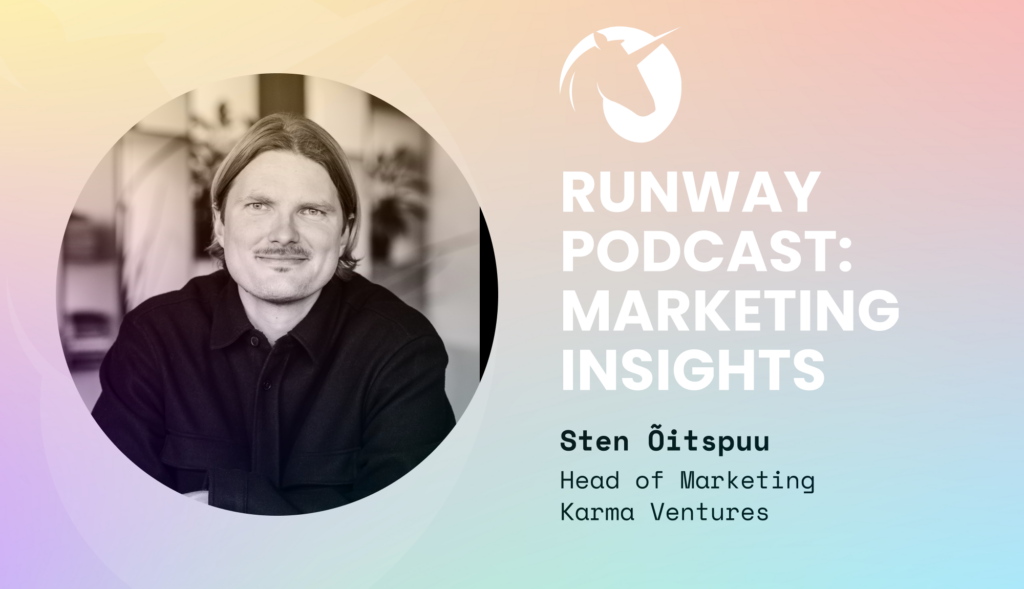
Most people who run marketing at a venture fund arrive from another fund, or from a startup, or from the agency world. Sten Õitspuu arrived from…. well, everywhere! He did two short stints in early-stage startups (one died, the other was the team that went on to build the avatar platform Ready Player Me, after four pivots to get there). Then he spent a decade across media and publishing, telco, and the creative industries, building marketing teams from scratch and producing large-scale events and audiovisual work. As he himself says, it looks eclectic on paper. But, pieced together, it was the best training for the job he does now: understanding startups, complicated organisations, and telling stories in both physical and digital spaces.
His route into Karma Ventures, the Tallinn-based fund backing European deep-tech software companies at late seed and Series A, was actually also quite unusual. It started around three years ago with a creative gig. An events company brought him in to work on the firm’s office opening party. From there, the relationship built quietly over the next eighteen months, until a conversation with one of the partners turned into a handshake. The official offer came the day before Karma’s summer offsite on a small Estonian island.

In a first for Runway, we recorded this one live for an audience on the podcast stage at Latitude59 in Tallinn, with JJ and Mauro hosting. What follows is a summary of the main insights Sten shared on the pod.
1. In VC, Marketing’s Real Job Is to Save Everyone Time
In a normal company, marketing prioritises any KPIs that lead to revenue. But VCs need their portcomps to generate revenue, so they can exit and create returns. What they need themselves is to make deals with the best startups. So in a venture fund, Sten argues, the metric is relationships and their quality. The question is not necessarily “how do we drive more leads,” because not all leads are equal. In fact, a fund like Karma makes few bets every year, and they have to be the right ones. So it is more a case of “what helps us build and sustain high-quality relationships.”
He also frames VC marketing as a way to help all parties save time. Time for founders deciding whether a fund is right for them, and for the investment team deciding whether a company is a fit. Every touch point helps make that more and more clear, and good marketing makes the answer self-evident as early in the funnel as possible.
Underneath it is a principle he keeps returning to: “what you see is what you get.” The promise on the website should match the experience in the room, both before the ‘cheque’ and long after it.
2. When You Build a Function From Scratch, Start by Listening
Karma had never had a marketing function, and Sten was building it from the ground up. That is exactly the situation where a new hire is tempted to plant a flag fast. The cliché version writes itself, doesn’t it? The new marketing person joins and immediately announces a brand refresh.
He did the opposite. He started with internal interviews, sitting down with the whole team more than once and mapping how they actually operate. Out of that came a master document, and a first-principles question: what is venture capital, really? Only after working that up over several months did the brand work begin, with an Estonian agency brought in to package it. The full process ran seven or eight months.
The lesson for anyone joining an unbranded organisation is that the value is usually already in the building. The three Karma partners had more than a decade each in VC, but externally this was not being properly reflected. The job was not to invent a brand. It was to externalise what was already there. TO be fair, a lot of brilliant European operators are sitting on exactly this kind of unspoken expertise, not only in VC funds, but also at startups and scaleups. The opportunity is rarely something exotic. It’s reflecting reality in the best possible way.
3. Values Belong in Decisions, Not Documents
Karma’s identity is built around the “Karma Method,” and it is less mystical than it sounds. Karma, from the Sanskrit, simply means action. Your current actions define your future outcomes. The method is a system of accountability for the support the team commits to its portfolio and the wider founder community.
The interesting part is how they handled values. The team landed on a familiar truth, which is that values are rarely practical, and most end up in documents nobody opens. So Karma reframed them as decisions. Instead of adjectives, they built faders. Direction over speed. Time over money. Precision over speed. Each decision gets nudged toward one end of the dial. It is not binary, but it gives the team a shared way to choose under pressure.
A value expressed as a trade-off (“we choose X over Y, even when Y is faster”) is something the team can use, and therefore something that a brand can be held to. Check out the Karma Method here.
4. Direction Over Speed: The Discipline of Not Shipping
The best illustration of the method in action is a project Sten killed. His own.
He got excited about launching a podcast (a classic move, he admits). The team was not. He pushed ahead anyway, recorded two episodes with proper visual production, and presented the result. Still no enthusiasm. His first reaction was to improve even further – recut it, swap the guests, fix the format. Then he stepped back and asked the harder question. Was he adding to the brand’s voice, or just producing more noise? He decided it was noise, and shelved the project.
The lesson is not “don’t make a podcast” (we would be poor advocates for that, hehe). It is that the willingness to walk away from your own work is an advantage in a world where shipping has never been cheaper. As Sten ties it back to Karma’s “creating choices,” there are usually more options on the table than the two bad ones you thought you were stuck with. The mark of a disciplined marketer is not how much they launch, produce or ship. In today’s world in which any idea can be executed, the key is having the confidence to bin what doesn’t give you a plus.
5. Use AI for Forklifting, Not Weightlifting
Sten’s favourite framing on AI came, fittingly, from a sauna. On a balcony with a group of founders, the conversation turned to whether AI is making us stupid because we stop doing the actual work. One founder offered an analogy Sten has used ever since: forklifting versus weightlifting tasks.
Weightlifting tasks are the ones you want to be genuinely good at: the thinking, the writing, the producing. Those are reps in the cognitive gym, and you have to keep lifting. Forklifting tasks (where the machine lifts for you) are the ones you just need done and have no ambition to master, and that is where you hand the load to AI. For the weightlifting work, AI is at most a thinking partner, not a substitute.
It matters in VC because of the authenticity risk. AI lets a busy investor or platform lead publish far more. You have probably seen the tells on LinkedIn, the suspiciously long posts, the templated comments, etc. And the danger is scaling your output while losing your voice. Sten’s own stack is lean. Claude Cowork, where he generates the small tools he is missing rather than waiting for software to exist, and Higgsfield as a visual aggregator. Useful names to know, but the principle outlasts the tools.

6. Everyone Says “Founder Friendly.” Almost Nobody Means It
Ask Sten what European funds get wrong and he does not hesitate. Too much mimicry. Funds insist they are different, then all sound identical. And one phrase makes him wince: “founder friendly.”
His objection is not that founder friendliness is bad. It is that as a sole tagline it is empty. If it is the only thing your communication says, you have said nothing. The fix is not a cleverer slogan, it’s authenticity and letting the actual humans behind the fund come through. These partners are the faces founders work with for years. Represent those real people honestly and you get back to “what you see is what you get.” There are funds in Europe doing this well, and funds in the US doing it just as well. The differentiator is not geography. It is whether anyone behind the logo is visible.
7. In an Age of Noise, Events Are the Signal
Given how easy content has become to produce, Sten is unusually energised by the least scalable channel of all — events. Physical presence forms relationships that cannot form any other way. You cannot control the conversation between two people in a room, but you can control the room and who you bring into it. That, he argues, is the big game.
Karma works on two tracks. It stays visible at the big ecosystem moments of the region (Latitude59, where we recorded this, plus Startup Fair in Lithuania and TechChill in Riga). And it curates smaller, higher-intent environments, the dinners and side events where peers meet peers and founders meet each other. Unlike larger funds with a dedicated events person and a KPI-driven calendar, Karma follows the relationships through its everyday work. The branded touches help – otherwise, ask anyone who earned a Karma t-shirt at their fifth Karma run, printed with “direction over speed”. But the logic is simple: in a market drowning in automated output, the rooms you build are the signal that cannot be faked.
The Main Takeaways
Working in marketing, comms or platform at a fund or a startup? If you cannot listen to the full conversation, here is a primer on what Sten shared:
- In VC, optimise marketing for relationship quality, not revenue. The job is to save time for founders and for your own team.
- Make fit or no-fit obvious as early in the funnel as possible. Every touch point either creates value or wastes it.
- Hold the line on “what you see is what you get.” Never let the brand promise more than the team delivers after the cheque clears. It’s better for the brand and the fund in the long term.
- Keep marketing and platform distinct. Marketing is what happens before the investment, platform is what delivers on it afterwards.
- Joining an fund with no marketing function? Interview internally before you touch the brand. The real story is almost always already in the building.
- Stop writing values as adjectives. Better, express them as trade-offs your team can actually use when choosing under pressure.
- Treat the willingness to kill your own project as a strength. If it adds noise rather than value, bin it.
- Split your work into weightlifting and forklifting. Keep doing the reps on what you want to be great at, and hand the rest to AI.
- Protect your voice. AI lets you publish more, which makes losing your authenticity easier, not harder.
- Retire “founder friendly” as a standalone line. If your positioning would fit a competitor unchanged, it is not positioning.
- Invest in events as relationship infrastructure. You cannot script the conversation, but you can choose the room and who is in it.
- Find a champion internally rather than trying to please everyone, and find the touch points that actually matter before you spend time or money.
🎧 This article is based on a conversation from The Runway Podcast featuring Sten Õitspuu, Head of Marketing at Karma Ventures, recorded live at Latitude59 in Tallinn. Listen to the full episode for the complete chat.
When Comms Meets Venture Capital, with Elisheva Marcus, VP Comms at Earlybird VC
How VCs Can Step Up Their Comms Game: Insights from Earlybird & FIRSTPICK
Adam Jennings on the Foundations of Branding
The Ins and Outs of LinkedIn for Startups, with Kotryna Kurt