Last week took us to Berlin for Stage Two, the pan-European competition for startups spinning out of universities. It was our first time involved with the event, and we jumped in right at the deep end. Black Unicorn PR was one of this year’s partners, and our very own JJ was the MC for the whole of competition day on 23 October.
Stage Two is not your usual conference pitch day. The startups are mostly deep tech, the founders on stage come from research labs and may be deep experts with PhDs. A lot of these universities have a rich history and connections to the world of industry and science. On the flip side, for many of these founders it was the first time pitching on a stage with hundreds of peoples and dozens of investors.
Here is our account of how the day unfolded, the eight startups that made the final and a bit of what Stage Two is.
First up, what is Stage Two?
Europe has no shortage of brilliant researchers, but a breakthrough in a lab is a long way from a company. A step is needed in between to help avoid the good science from stalling. That’s the idea behind Stage Two, initiated by RWTH Aachen University and HHL Leipzig Graduate School of Management, and which this year was in its sixth edition.
So why is it called Stage Two? Well, the competition runs in two parts. Stage One happens at each partner university between March and July, where local entrepreneurship centres pick their best early-stage teams. Stage Two is the final in Berlin, where those nominees pitch to a network of European investors and industry leaders. Cool, huh!
Some numbers to give you a sense of the scale: since 2021, 298 startups and 964 founders have come through it, from 73 universities and entrepreneurship centres across 27 countries. This year alone brought around 50 startups from 48 universities in 24 countries, competing for more than €5M in investment and accelerator prizes.
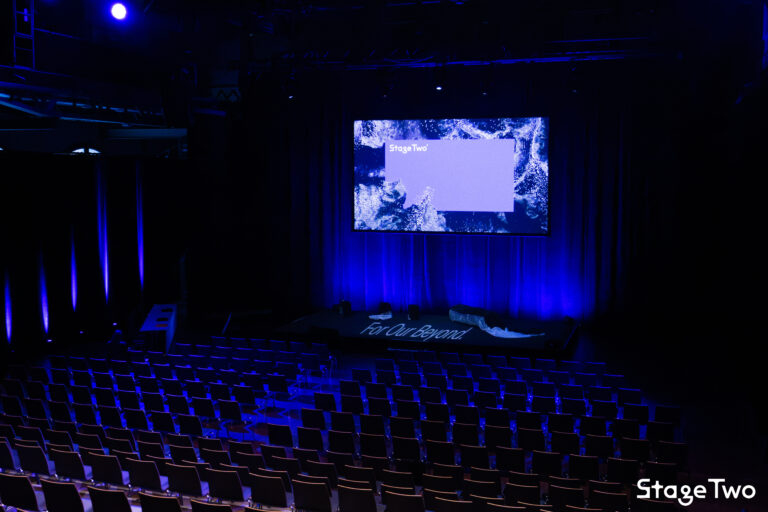
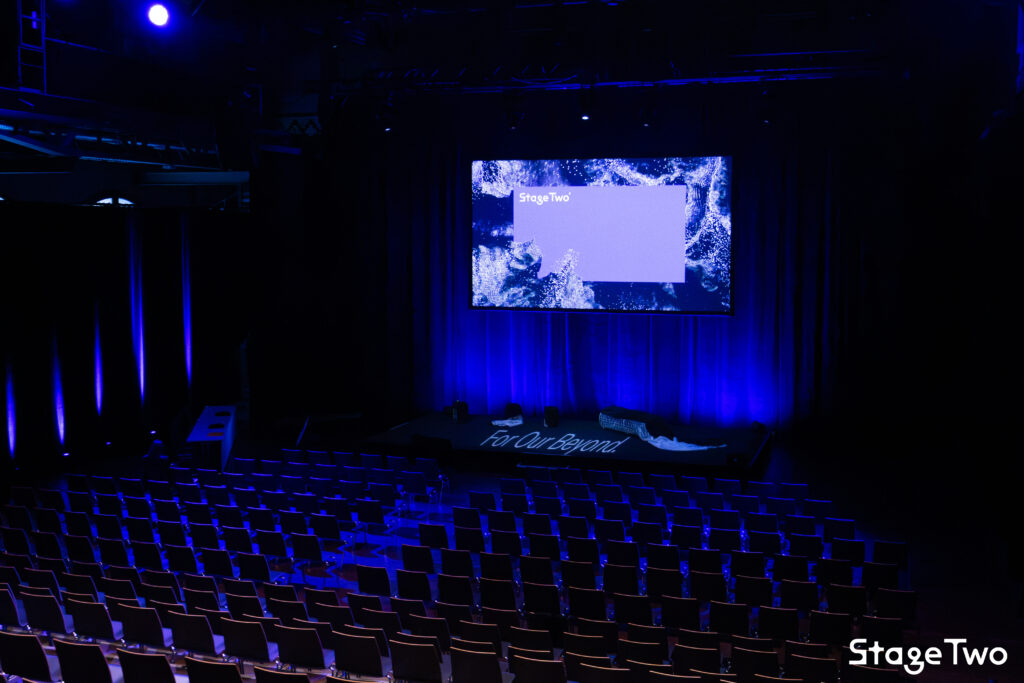
The finals take place at Radialsystem on Holzmarktstraße near the East Side Gallery, where you can admire art on old pieces of the Berlin wall. The building is a former pumping station on the banks of the Spree. Brick walls, high ceilings and a river view. A fitting place with lots of history, fitting of an event focusing on deep tech and the physical world.
23 October: semi-finals, a fireside chat and the final
Disclaimer: we begin with Day 2, so for all the Day 1 info, please check out Stage Two’s channels!
On Day 2, the event opened with a welcome from the two people who started it all, Prof. Malte Brettel of RWTH Aachen and Prof. Stephan Stubner of HHL (Leipzig). Julia Beck, Chief Growth Officer at eleQtron, followed with a keynote on the cultural, technical and personal side of scaling in deep tech. eleQtron is itself a university spin-off, founded in 2020 out of the University of Siegen to build trapped-ion quantum computers controlled by microwaves rather than lasers. In May 2026 it raised a €57M Series A led by Schwarz Digits, one of the largest Series A rounds in quantum computing worldwide. Inspiration for a lot of the founders that were pitching.
Then came the heart of it all, the startup pitches! And a lot of them. Four semi-finals were running in parallel, two for Digital and Business Innovation and two for Tech Innovation. Each had its own moderator and a five-person investor jury, with Victoria Hoffmann (SectorPi), Tom Nugent (Sifted), Patrizia Jurek (Google) and Cate Lawrence (Tech.eu) as moderators, and keeping the four rooms on time (and just in case, there was an atomic clock startup there too). The jury benches included partners and investment teams from Earlybird-X, redalpine, HTGF, Lunar Ventures, Armilar, Creator Fund and many more.
After lunch and the Future Expo, a fireside chat asked a question that many in Europe would like to know the answer to. How do we get private capital to show up? Alina Bassi (Earlybird) moderated, and Merete Clausen (European Investment Fund) and Tobias Henz (McKinsey) unpacked, under the banner “Make Europe invest again!” Great macro level insights to understand Europe’s current potential and limitations.
Then, the big final. JJ brought the eight finalists to the stage one by one, in front of a jury of Melanie Higgs (Auxxo), Eltonjohn D’souza (Redstone), Sebastian Lindner-Liaw (World Fund), Mira Kamp (redalpine) and Nils Eiteneyer (Capnamic).
The focus is on the startups, of course, we experienced the reality of the MC’s role from up close: it was crucial to keep the energy up, keep things moving and make sure every founder got the recognition they had earned. That meant getting the whole room on its feet with loud clapping and stomping between pitches. If you wondered whether the crowd would be too shy for it, we can tell you it was quite the opposite.
For JJ, though, one of her fondest memories is from what happened backstage. Chatting to founders about their ideas, asking whether they were nervous, and passing on a few tips for standing on a stage. In a few minutes each, they had to show that their science works, why it matters and how it becomes a real business. Whether they were nervous or not, it didn’t show. They all nailed it.
And there was also plenty on the line. The prizes on offer included investment tickets of €500 to €750k, as well as three prizes of €1M in investment. We will leave you to find out who the winners were by going on Stage Two’s channels. Oh, and make sure you follow them on LinkedIn!
The eight finalists of Stage Two 2026
Algaenius, Erasmus University Rotterdam
Most of the world’s water contains salt, and the way we remove it today is expensive and carbon-heavy. Algaenius, founded by Meinke van Oenen, uses halophilic (salt-loving) algae to desalinate seawater for agriculture and industry. The algae take up 70 to 90% of the salt depending on temperature, and the warmer it gets the better they work, which suits the places where water is scarcest. They also absorb CO₂ along the way, so the process tackles water scarcity and one of its causes at the same time.
Find out more: Algaenius on LinkedIn
catchfree, University of St.Gallen
Overfishing is putting the oceans under pressure, and farmed fish come with their own problems. catchfree, founded by Severin Eder and Eduard Müller, makes plant-based seafood for restaurants: shrimp, fish burgers and fish bites made from ingredients like rice, soy protein and microalgae. It is already past the lab stage, with more than 100 Swiss restaurants serving its products, and earlier this year it won the Startfeld Diamant award for the best young company in Eastern Switzerland.
Find out more: catchfree.ch
Cloq, University of Oxford
Telecoms networks and GPS infrastructure depend on extremely precise timing, and the atomic clocks that provide it are large and expensive. Cloq, a team of Oxford physics and engineering students, is commercialising a miniaturised, low-cost quantum clock based on University of Oxford research. Before Berlin, the team won the top prize at the Reuben Entrepreneurship Forum and placed second in Oxford’s Student Entrepreneurship Programme.
Magnetic Future, University of Bologna
Superconducting magnets power fusion reactors and MRI scanners, but feeding them current means running copper leads into a cryogenic bath, which leaks heat and burns energy. Magnetic Future builds flux pumps, contactless power supplies that sit inside the cold environment with the magnet. The team says this cuts the electricity needed to power the magnet by up to 99% in fusion and makes superconducting magnets light and efficient enough for spacecraft. It has already signed letters of intent with companies in the fusion and space sectors.
Find out more: magneticfuture.eu
Oghma, Trinity College Dublin
Materials science R&D runs on data, but much of it sits scattered across papers, patents and decades of reports written to shifting standards. Oghma builds agentic AI systems that mine those sources and turn them into structured, machine-learning-ready datasets that slot into a lab’s existing workflow. Clients already include BASF, where Oghma converted 30 years of historical R&D records with 99.7% accuracy on a control set, and pharma R&D company APC, for which it built a 25,600-entry solubility dataset.
Find out more: oghma.ie
Prehensio, WHU Otto Beisheim School of Management
Robots are good at picking up the same part from the same place a thousand times, and much worse at handling objects they have never seen. With commercial robot hands now widely available, the bottleneck has moved from hardware to the slow, part-by-part configuration of each grip. Prehensio, a spin-out of Fraunhofer IPA with WHU alumnus Franz Dornbach as business co-founder, builds software that automatically chooses a suitable grip based on where an object is detected. Its first applications are machine loading and order picking in production and logistics.
Find out more: prehensio.ai
aiXopt, RWTH Aachen University
Production machines are full of settings, and tuning them is usually slow, manual work that leaves performance on the table. aiXopt, founded by Tim Reuscher and David Stenger with Prof. Sebastian Trimpe out of RWTH research in machine learning and control engineering, builds AI software that optimises machine settings automatically, using a small-data approach that works with the production data a factory already has. The aim is days of tuning instead of months.
Find out more: aixopt.ai
FreeForm Photonics, Heriot-Watt University
More than half of the cost of producing photonic components comes from aligning them by hand. FreeForm Photonics, led by Dr Calum Ross, uses a laser-based process to build the alignment directly into optical glass components, so precision is designed in from the start rather than calibrated in afterwards. The Heriot-Watt spin-out has funding from Scottish Enterprise’s High Growth Spinout Programme, with applications across optical sensing and communications.
Find out more: freeformphotonics.com
Where Europe’s next deep tech companies get started
Stage Two is bridging the most important gap in startups, now that the focus is shifting from software to hardware, from the digital to the physical. It’s also an area where Europe can really thrive. Its incredible talent, top universities and researchers give it so much potential.
Stage Two puts university founders, from Oxford to RWTH and everyone in between, in one room with investors, the industry and each other, long before there is a funding round or a headline. The prizes are considerable, even bigger than some of the big startup conferences out there. But every team left with something valuable: a room full of people who now know who they are. Good science still needs a story that an investor, a customer or a journalist can follow. What happens at the lab is important, but communicating it to investors, customers and the wider world is also needed, or the impact might never materialise. And so, we get closer to tapping that potential.
What an honour to be a part of it.
A huge thank you to Lukas Ellmann, Malte Brettel, Stephan Stubner, Leon and the whole Stage Two team for an event that ran like clockwork and still felt warm and human. And congratulations to all the founders who pitched.
Vielen Dank and until the next one!